In nearly every real estate contract, the seller agrees to provide the buyer with title insurance. Before closing, we send you a title commitment to review.
A title commitment is our formal promise to issue a title insurance policy once certain conditions are met. It contains the same terms, conditions, and exclusions that will appear in your final policy, and it lists everything that has to be resolved before that policy can be issued.
Most people open it, see five pages of legal description and recording numbers, and close the file. This guide walks through each section so you know exactly what you're looking at and what deserves your attention.
What Is an ALTA Commitment?
The full name of the document is the Commitment for Title Insurance, published by the American Land Title Association (ALTA). You'll also hear it called an ALTA commitment, a title binder, or just "the commitment."
First Alliance Title issues the ALTA Commitment for Title Insurance (2021 v. 01.00), effective July 1, 2021, on the Colorado-adopted version of the form. If you've seen an older commitment, it was likely the 2006 or 2016 form. ALTA decertified the 2006 policy and endorsement forms on December 31, 2022.
A valid commitment has five parts plus an authorized countersignature, which may be electronic:
- Notice and Commitment to Issue Policy. States that this is an offer to issue a policy, not an abstract of title or a guarantee of title status. It terminates six months after the Commitment Date if requirements aren't met.
- Commitment Conditions. Terms governing liability limits, who may rely on the commitment, and claims procedures.
- Schedule A. The facts of your transaction.
- Schedule B, Part I: Requirements. What must happen before we can issue the policy.
- Schedule B, Part II: Exceptions. What the policy will not cover.
One change worth knowing in the 2021 form: Schedule B-II now carries mandatory language stating that any illegal, unenforceable discriminatory covenant appearing in a referenced historical document is treated as redacted and repudiated.
Schedule A: The Facts of Your Deal
Schedule A is the shortest section and the one you should read most carefully. An error here follows the transaction all the way to your policy. It contains five numbered items:
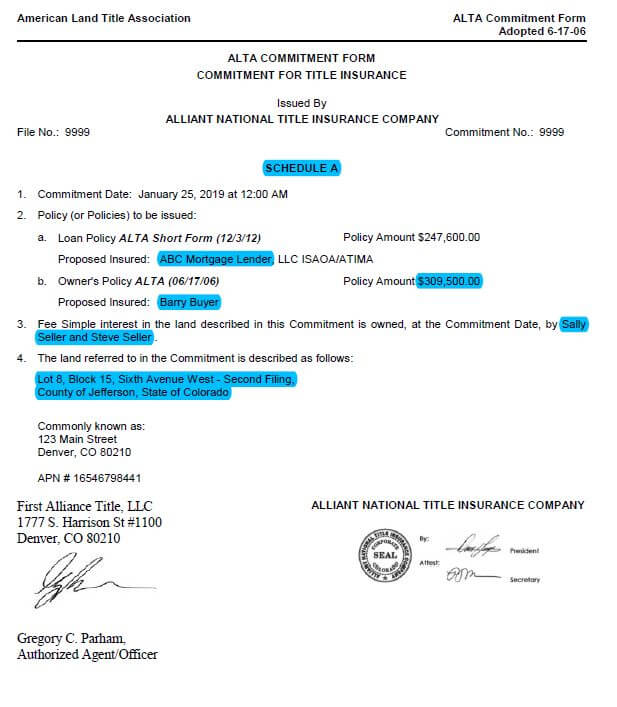
1. Commitment Date. The exact date and time through which we searched the public records. Anything recorded after this timestamp isn't reflected yet, which is why we run a final "date-down" search right before closing.
2. Policy or Policies to Be Issued. Identifies the form of policy (2021 ALTA Owner's Policy, 2021 ALTA Loan Policy, or both), the Proposed Insured, and the Proposed Policy Amount. The owner's policy amount is typically the purchase price. The loan policy amount is the loan principal.
Check that your name is spelled exactly as you want it on title. If you're taking title as a trust or an LLC, the entity name must match your formation documents.
If you're financing, your lender's name will be followed by ISAOA/ATIMA. That stands for "Its Successors and/or Assigns" and "As Their Interests May Appear." It extends coverage automatically if your loan is sold on the secondary market, which saves your lender from reissuing a policy every time the loan changes hands.
3. Estate or Interest in the Land. The type of ownership being insured.
Estate type | What it means |
|---|---|
Fee Simple | Full, indefinite ownership. The standard for most residential and commercial purchases. |
Leasehold | The right to possess and use land under a recorded lease, not ownership of the land itself. Common in ground leases. |
Easement | A non-possessory right to use someone else's land for a specific purpose, usually insured alongside a fee simple parcel. |
Life Estate | Ownership limited to the lifetime of a named person, after which title passes to a remainderman. |
Condominium | Fee simple title to the unit's interior airspace plus an undivided interest in common elements. |
4. Title Vesting. The exact name of the current record owner and the instrument they took title by. Confirm this matches the seller on your contract. If it doesn't, that gap has to be explained before closing.
5. Legal Description. The formal boundary description, either metes and bounds or a lot/block/subdivision reference. This is what actually gets insured. The street address listed above it is informational only and carries no liability.
Schedule B, Part I: Requirements
Schedule B-I is the to-do list. These items must be satisfied before we issue your policy. Anything left unresolved either becomes an exception on Schedule B-II or prevents the policy from being issued at all.
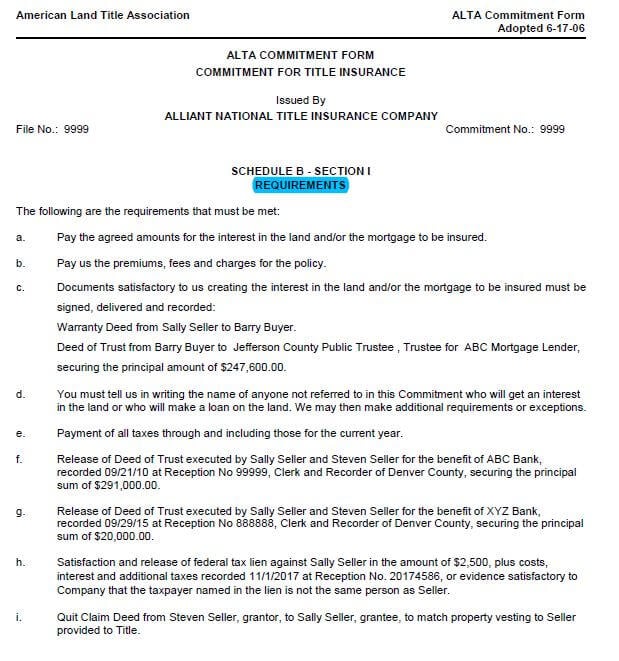
Typical requirements include:
- Payment of purchase price, loan funds, and title premiums.
- Execution and recording of the new deed and, if financed, the new deed of trust.
- Payoff and release of existing liens. Seller's mortgage, HELOCs, judgment liens, mechanic's liens, and tax liens.
- Payment of current and delinquent property taxes, special assessments, and HOA dues.
- Entity and fiduciary documentation. For an LLC or corporation: articles, operating agreement or resolution, and certificate of good standing. For a trust or estate: certification of trust, death certificate, or letters testamentary.
- Owner's affidavit. The seller swears there are no unrecorded leases, no undisclosed parties in possession, and no recent work that could generate a mechanic's lien.
- Notice of additional parties who will take an interest or make a loan on the property.
How Colorado releases a paid-off mortgage
Colorado uses a three-party deed of trust rather than a mortgage, so releasing a paid-off loan works differently than in most states. The parties are the grantor (borrower), the beneficiary (lender), and the county Public Trustee, under C.R.S. § 38-39-102.
After we wire payoff funds, a release package goes to the Public Trustee in the county where the property sits. There are two tracks:
- With production of evidence of debt. Used by private note holders. Requires the original promissory note marked "Paid in Full," a notarized Request for Release, and a copy of the recorded deed of trust.
- Without production of evidence of debt. Available to qualified institutional lenders and licensed Colorado title insurance companies under C.R.S. § 38-39-102(3). No original note required, and it's typically submitted electronically.
The Public Trustee then executes and records the Release of Deed of Trust. Under HB 24-1269, counties charge a flat $73.00 for this.
Federal tax liens
If a Notice of Federal Tax Lien shows up, it attaches to all of the seller's property and has to be dealt with before we can insure clean title.
If the seller has enough equity, we request an official payoff from the IRS Centralized Lien Operation and wire it at closing. Under IRC § 6325, the IRS issues a Certificate of Release within 30 days of full satisfaction.
If the proceeds won't cover the debt, the seller applies for a Certificate of Discharge using IRS Form 14135 under Publication 783, which removes the lien from this specific parcel so the sale can close. Build in 30 to 45 days before closing for that application.
Schedule B, Part II: Exceptions
Schedule B-II is what your policy will not cover. This is the section buyers skip and later regret skipping, because these items affect how you can actually use the property.
Exceptions come in two types:
Standard exceptions | Special exceptions | |
|---|---|---|
Where they come from | Pre-printed, appear on nearly every commitment | Specific recorded documents found in the search of your parcel |
Examples | Unrecorded easements, survey discrepancies, parties in possession, unrecorded mechanic's liens, the "gap" | Utility easements, subdivision CC&Rs, HOA declarations, plat notes, mineral reservations |
Can they be removed? | Usually, through Owner's Extended Coverage | Generally no. They're valid recorded rights that run with the land |
The Colorado standard exceptions
Most Colorado commitments list these, though numbering varies slightly by underwriter:
- Parties in possession. Rights not shown in the records that an inspection or inquiry would reveal, like an unrecorded tenant.
- Unrecorded easements. Easements or encumbrances not in the public records.
- Survey matters. Boundary conflicts, shortages in area, and encroachments a correct survey would disclose.
- Unrecorded mechanic's liens. Liens for labor or materials not yet shown in the records.
- The gap. Anything recorded between the Commitment Date and the moment you acquire title of record.
- Prior unpaid taxes and tax sales. Followed by a separate exception for current-year taxes, a lien not yet due and payable.
- Mining claims and patent reservations. Common in Colorado, where original federal patents often reserved minerals, ditches, or rights-of-way.
- Water rights. Standard in Colorado, where water is governed by prior appropriation and water court decrees, separate from land title.
Removing standard exceptions: Owner's Extended Coverage
In Colorado, deleting exceptions 1 through 5 or 6 is called Owner's Extended Coverage (OEC). Section 8.1.3 of the Colorado contract has checkboxes for whether the commitment will include OEC and who pays the additional premium: seller, buyer, or split 50/50.
To actually delete them, the underwriter typically needs:
- Owner's affidavit from the seller, which clears exceptions 1 and 4.
- Improvement Location Certificate (ILC) or an existing survey with a seller's no-change affidavit for residential property, which addresses 2 and 3. Commercial or vacant land usually requires a current ALTA/NSPS survey or Improvement Survey Plat. Note that any encroachment the ILC reveals gets added back as a special exception.
- Pre-closing date-down search and recording, which clears exception 5 automatically.
- Tax certificate verification, which clears exception 6.
Exceptions 7 and 8, patent reservations and water rights, generally stay on the final policy even with OEC.
Severed mineral rights
Colorado is a split-estate state. Subsurface oil, gas, and minerals are frequently owned separately from the surface.
Under C.R.S. § 10-11-123, we're required to notify you in the commitment if the public records show the mineral estate has been severed. On Schedule B-II you'll see a specific exception citing the reception number of the deed or patent that reserved the minerals, and often a general note stating that the policy does not insure the mineral estate and that the mineral owner holds an implied right of reasonable surface access.
Two limits worth understanding. The commitment identifies the document that severed the minerals. It does not tell you who owns them today, and it does not check for active oil and gas leases. If that matters to you, order a mineral title search from a landman or oil and gas attorney during your objection period.
Title Commitment vs. Title Policy vs. Title Report
These get used interchangeably and they shouldn't be.
Title Commitment | Final Title Policy | |
|---|---|---|
When issued | Before closing | After closing, once documents record |
What it is | A conditional offer to insure | An executed contract of indemnity |
Effective date | Commitment Date (search-through date) | Date of Policy (when instruments record) |
Schedule B-I | Present, lists requirements | Removed entirely |
Lifespan | Terminates 6 months after the Commitment Date | Lasts as long as you hold an interest in the property |
A few related terms:
- Preliminary title report. Used primarily in California and parts of Washington, Oregon, Nevada, and Hawaii. Under California Insurance Code § 12340.11, a prelim is explicitly not a binding offer to insure, and liability attaches only when the policy issues. Colorado uses commitments, which do carry contractual liability.
- Title binder. Mostly a synonym for commitment. In commercial and investor resale deals, a "hold-open" binder keeps the commitment open 12 to 24 months so an investor reselling the property pays only on the increase in value instead of buying two full policies.
- Pro forma policy. A mock-up of exactly how the final policy will read, prepared before closing for counsel to approve. Common in commercial deals. It provides no coverage until the real policy issues.
- Attorney title opinion. A lawyer's letter certifying marketable title after examining an abstract. Still used in parts of the Midwest and Southeast. It covers the attorney's negligence in examining the records. It does not cover hidden off-record defects like forgery, undisclosed heirs, or recording errors, which title insurance does.
Your Title Deadlines Under the Colorado Contract
The Colorado Real Estate Commission's Contract to Buy and Sell Real Estate sets title deadlines as negotiated calendar dates in the Dates and Deadlines table (§ 3.1), governed by Section 8. There is no fixed statutory number of days.
- Record Title Deadline (§ 8.1, § 8.2). When the title commitment and tax certificate must be delivered. By default the seller selects the title company under § 8.1.1 unless § 8.1.2 is checked for the buyer.
- Title Documents (§ 8.2). By the same deadline, you must receive copies of every recorded document listed in Schedule B-II: plats, declarations, and CC&Rs.
- Off-Record Title Deadline (§ 8.3). When the seller delivers known off-record matters, like unrecorded leases or boundary agreements.
- Record Title Objection Deadline (§ 8.2). Your written deadline to object or terminate. Miss it and you're deemed to have accepted title as shown.
- Title Resolution Deadline (§ 8.7). When objections must be resolved or withdrawn, or the contract terminates.
In a typical 30-day residential closing, the Record Title Deadline often lands 7 to 10 days after mutual execution, with the objection deadline 3 to 7 days after that. Your contract controls.
One protection worth knowing: under § 8.2, if the commitment, title documents, or an endorsement arrives after the Record Title Deadline, your objection deadline automatically extends to the earlier of five calendar days after you receive them, or closing.
Our commitments include hyperlinks to the recorded documents referenced in Schedule B-II, so you can pull an HOA declaration or easement without a trip to the Clerk and Recorder.
Frequently Asked Questions
What does "title commitment complete" mean? It means the examiner has finished searching the public records and the full commitment package has been drafted, reviewed, and delivered. It does not mean the Schedule B-I requirements have been cleared. Those get satisfied leading up to and at closing.
How long is a title commitment good for? Six months from the Commitment Date under the 2021 ALTA form's Notice provision. In practice it's shorter, because we run a date-down search within 24 to 72 hours of recording to catch anything filed during escrow. If closing slips past six months, we issue an updated commitment with a new Commitment Date.
What is a marked-up title commitment? A copy annotated and signed by a title officer at the closing table showing the exact state of title at funding. Schedule A gets updated to the recording date, B-I items get marked satisfied or paid, and cleared exceptions get struck. Because the printed policy takes weeks to generate after county recording numbers come back, the marked-up commitment serves as immediate proof of coverage.
Who pays for title insurance in Colorado? Negotiable under § 8.1, but custom splits it this way: the seller typically pays for the owner's policy, the buyer typically pays for the lender's policy, and OEC is negotiated separately in § 8.1.3 as seller, buyer, or split. When both policies issue together, a discounted simultaneous issue rate applies rather than two full premiums.
How long does it take to get a title commitment? Three to five business days for a standard residential purchase after we receive the executed contract and open the order, often faster in counties with digitized title plants. Commercial, metes-and-bounds, or complex entity transactions typically run 7 to 14 business days.
What's a date-down endorsement? It moves the effective date of coverage forward. Before closing, we run a date-down search from the Commitment Date to the recording date to confirm no new liens, IRS filings, or lis pendens appeared. On construction loans, lenders require a construction date-down endorsement (the ALTA 32 and 33 series) before releasing each draw, confirming no mechanic's liens attached since the last advance.
How do I request a title commitment? Email your executed contract to [email protected] or submit it through our online ordering portal. We onboard every real estate broker in advance, so your file gets processed according to your stated preferences from the first order forward.
Questions About Your Commitment? Ask Us.
A title commitment is dense by design. It's a legal document doing legal work. But you shouldn't have to guess at what's in it, and you shouldn't discover a surprise easement the week of closing.
If a requirement or exception doesn't make sense, reach out to our team. We'd rather spend fifteen minutes on the phone now than troubleshoot at the closing table.
Ready to open an order? Email [email protected] or contact our team.
Prefer to talk it through first? Our sales team covers the Denver and Boulder metro and can walk you through our process:
- Vince Malara, Sales Manager — [email protected] | (303) 549-2514
- Gracie Gallego, Vice President — [email protected] | (720) 317-9424
View all First Alliance Title locations
This article is general information about Colorado title practice, not legal advice. Your contract and commitment control your transaction. Consult your real estate attorney for advice on your specific situation.