Welcome to Boulder, CO
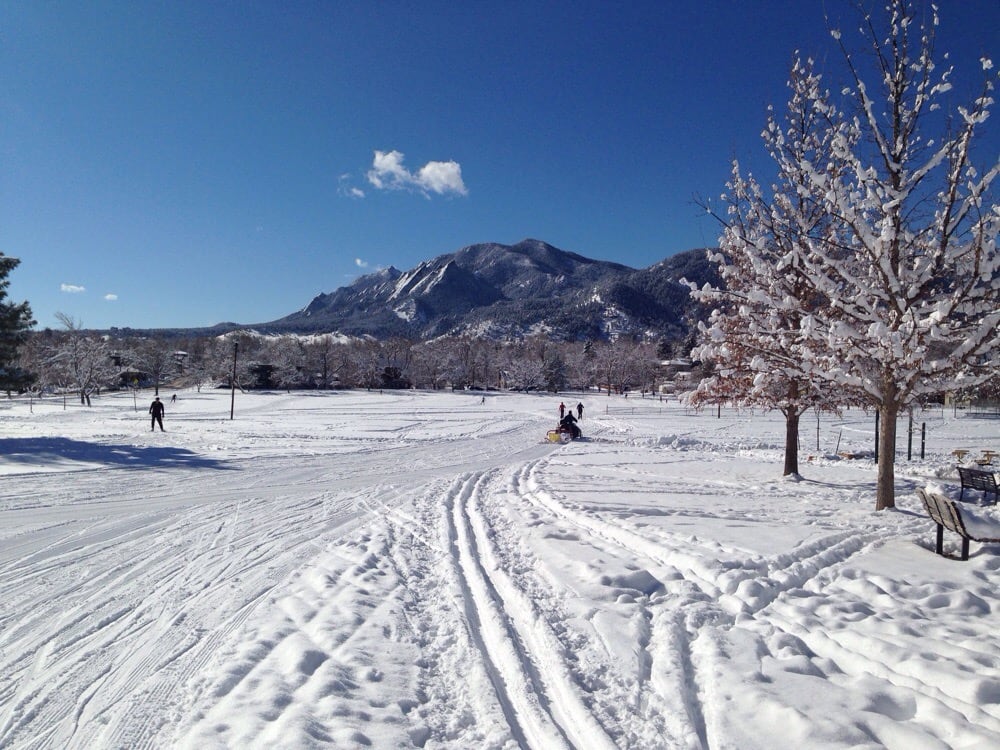
Boulder sits at the exact seam where the Great Plains give way to the Rocky Mountains, and that geography explains almost everything about how the city lives and how its real estate behaves. Framed by the Flatirons to the west and hemmed in on every side by legally protected open space, Boulder functions less like a typical Front Range suburb and more like a self-contained bubble — one that blends elite athletic culture, a powerhouse tech and scientific economy, and one of the most supply-constrained luxury housing markets in the country.
What makes Boulder distinct isn't any single feature but the way its pillars reinforce one another. The University of Colorado Boulder and a cluster of federal research labs draw a hyper-educated population; that population fuels a startup economy anchored by major tech offices; and the city's decades-long commitment to preserving green space gives all of those residents a mountain playground accessible from their own backyards. The result is a place where a morning trail run and an afternoon venture pitch feel equally native.
For a buyer, the takeaway is simple: Boulder is expensive, competitive, and highly regulated by design — but the payoff is a quality of life and a scarcity value that few American cities can match.
Local Housing Market at a Glance
The single most important fact about Boulder's housing market is that the city physically cannot grow outward. Roughly 46,000 acres of legally protected open space form a permanent green belt, capping inventory in a way no ordinary zoning decision could. Pair that self-imposed scarcity with sustained national demand, and you get one of the most expensive residential enclaves in the United States.
That said, the market has undergone a real psychological shift. The frantic, over-asking bidding wars of the post-pandemic years have given way to a more selective, turnkey-driven environment where buyers navigate high borrowing costs with far greater deliberation. Well-located, beautifully updated homes still command premiums and sell quickly, while properties with dated finishes or awkward layouts now linger. Notably, a solid majority of Boulder homes currently close below original list price — a meaningful reversal from recent history, and a sign that sellers who overprice face cuts and extended timelines.
A quick snapshot of where the market stands:
Indicator | Approximate Metric |
|---|
Median home value | ~$950,000–$980,000 |
Average monthly rent | ~$2,420 (well above national averages) |
Sale-to-list dynamic | High share of homes closing slightly under asking |
Inventory | Reliably tight, often a 2-to-3 month supply |
The micro-markets diverge sharply. Single-family homes under roughly $2M remain fiercely competitive, while the attached condo and townhome segment moves at a more measured pace, giving buyers a bit more room to think.
Lifestyle and Community Character
Boulder's culture rests on three legs: health, intellect, and the outdoors. It's a city where physical vitality is woven into daily life so thoroughly that it's frequently ranked the fittest city in America — an actual training ground for Olympic marathoners, professional cyclists, and world-class climbers. That obsession spills into the local economy, which holds the nation's highest concentration of natural and organic product companies (Celestial Seasonings among the pioneers) and supports a dense, allergy-conscious, farm-to-table dining scene.
Don't let the activewear aesthetic fool you, though. Boulder is intensely brainy. The CU Boulder footprint, combined with seventeen federally funded research laboratories including NOAA and NCAR, makes this a genuine hub of scientific and technical talent — one that also anchors offices for major tech companies. When residents power down, they tend to gravitate toward the city's celebrated craft brewery scene.
There is a cultural undercurrent worth naming honestly. Boulder is politically progressive and outwardly laid-back, but its astronomical housing costs have driven significant gentrification, shifting the town over decades from a bohemian haven into a wealthy tech enclave. Because billionaires and college students shop the same grocery stores and share the same trails, the wealth gap is a visible part of daily life. Newcomers often observe that while the town is friendly, its social circles can feel niche and insular, organized tightly around shared, high-intensity hobbies.
Outdoor Recreation and Open Space Access
In most cities, outdoor recreation is a weekend pursuit. In Boulder it's the primary organizing principle. The Open Space and Mountain Parks (OSMP) department manages more than 46,000 acres of protected land and roughly 150 miles of trails, a system that doubles as both a recreational amenity and a permanent buffer against sprawl. The reason this exists is itself a point of local pride: Boulder voters taxed themselves starting in 1967 to buy and preserve green space, a decision that continues to define the city's character.
The access is genuinely immediate. Trailheads at Chautauqua and Mt. Sanitas sit right at the edge of the city grid, offering instant verticality — locals routinely knock out a 1,300-foot climb before their first morning call. These iconic western trails are congested and deeply loved, and to protect fragile ecosystems, mountain biking is channeled away from them toward specific areas like Marshall Mesa and the northern foothills. That multi-use tension between hikers, runners, and cyclists is a real feature of trail life here.
Two details capture how seriously Boulder takes its outdoor identity. The first is the Voice and Sight Program, which lets registered dog owners take their dogs off-leash on designated trails after completing a training course and demonstrating vocal and visual control. The second is the Boulder Creek Path, a completely car-free corridor cutting from the canyon down through the heart of the city, letting kids bike to school and professionals commute to work entirely decoupled from road traffic.
Schools and Education
For families, the public school system is often the factor that justifies Boulder's steep housing premium. The city is served by the Boulder Valley School District (RE-2), consistently ranked among the top two districts in Colorado.
BVSD is one of very few large Front Range districts to routinely earn the state's highest rating, Accredited with Distinction. Standardized scores outpace state averages by wide margins, and high schools like Boulder High and Fairview High are perennial fixtures in national "Best High Schools" rankings. The district also pays the highest average teacher salaries in Colorado, which keeps talent retention strong.
One important nuance for relocating families: Colorado operates under a strict Open Enrollment policy, so parents aren't locked into their neighborhood school and can apply elsewhere during an annual winter window. The catch is that high-demand schools fill quickly through a lottery, which means living within a desirable school's boundary remains the safest way to secure a spot.
Boulder also has a deep appreciation for non-traditional education, all publicly funded:
- Traditional high-performers like Fairview High, known for rigorous International Baccalaureate tracks and extensive AP offerings.
- Focus and charter schools such as Peak to Peak (Lafayette) and High Peaks Elementary, emphasizing specialized, college-prep curricula.
- Experiential and alternative programs like Horizons K-8 and Boulder Universal, which lean into self-directed and environmentally focused learning.
Worth flagging for buyers: because rising prices have pushed out many young middle-class families, core-city elementary enrollment has faced downward pressure, and the district actively shifts resources and adds focus programs to keep neighborhood schools vibrant.
Commute, Transit, and Accessibility
Boulder approaches transportation unlike a typical American suburb, having spent decades deliberately designing infrastructure that discourages solo car travel in favor of transit, cycling, and walking.
At the center of local transit culture is the EcoPass — an annual, unlimited-ride RTD transit pass that's heavily subsidized and frequently provided free by employers, neighborhoods, and the university. Rather than dull route numbers, Boulder runs a color-coded Community Transit Network: The HOP loops the downtown, Twenty Ninth Street Mall, and CU campus corridors; The SKIP runs north-south along Broadway as the city's spine; and The JUMP and BOUND handle east-west and cross-town travel.
Regional connections lean heavily on the highway network. The Flatiron Flyer offers rapid bus service down US-36 to Denver, and the AB line runs directly to Denver International Airport, a real convenience for frequent travelers. The perennial local frustration is the long-promised commuter rail link to Denver, which remains undelivered and keeps regional transit highway-dependent.
For daily movement inside the city, cycling is the real story. Boulder is rated a Platinum-level bicycle-friendly community, with hundreds of miles of dedicated lanes and grade-separated paths — meaning you pass beneath major roadways rather than crossing them. Combined with an extensive e-bike sharing program, this leads a substantial share of residents to forgo cars entirely for local trips.
Home Types and Architecture
Because Boulder is geographically locked and tightly governed by preservation laws, you won't find rows of cookie-cutter subdivisions. Instead, individual blocks often display a centuries-spanning timeline of architectural styles.
In the historic core — Mapleton Hill, Whittier, University Hill — the housing dates to the late 19th and early 20th centuries. Here you'll find Queen Anne and Victorian homes with steep roofs, asymmetric facades, and wrap-around porches, alongside dense clusters of Craftsman bungalows with low rooflines, exposed rafters, and tapered stone or brick porch pillars. These are strictly protected by historic landmark boards, so exterior renovations require intensive permitting.
As Boulder expanded through the 1950s and 60s, South and East Boulder filled with Mid-Century Modern and ranch-style homes — low, wide profiles and open floor plans. Today these are the prime targets for luxury "pop-tops," where a buyer purchases a single-story ranch and builds a second story on top, or scrapes and rebuilds entirely.
Up in the canyon cuts and foothills, the defining high-end style is Mountain Modern: massive floor-to-ceiling glass walls framing Flatirons views, asymmetrical geometry, rusted steel or corrugated metal accents, and heavy use of native Colorado timber and stone, all designed to blend into the landscape rather than interrupt it.
One constraint applies to nearly every project: Boulder enforces some of the strictest green building and solar-access laws in the country, along with a longstanding height limit (historically around 55 feet) that protects shared mountain views. Any new build or major scrape must meet rigorous energy-efficiency standards, which heavily incentivize net-zero and solar-equipped construction.
Cost of Living and Affordability Considerations
Living in Boulder requires a substantial financial baseline. The overall cost of living runs roughly 30% to 39% above the national average and nearly 18% above the Colorado average, with housing driving the disparity. Median home prices hover between about $950,000 and $1.1 million, and even a basic one-bedroom rental typically runs $1,800 to $2,400+ monthly depending on proximity to downtown.
Everyday costs track higher too, largely because of local preferences. Baseline groceries are manageable, but the culture leans toward premium organic and locally sourced products, so shopping the farmers' market or specialty grocers pushes food budgets up. Utilities carry real weight given cold winters and increasingly warm summers, and childcare is a significant line item — full-day care easily scales past $1,600 per month per child, reflecting Colorado's high national ranking for childcare costs.
Perspective matters enormously here. How expensive Boulder feels depends almost entirely on where you're coming from:
Moving to Boulder from... | Relative cost shift |
|---|
San Francisco, CA | ~36% less expensive |
New York, NY | ~26% less expensive |
Boston, MA | ~10% less expensive |
For transplants from lower-cost metros in Texas or the Midwest, the sticker shock can be severe. For those relocating from tier-one coastal markets, Boulder can feel like relief.
Buyer Considerations
The Boulder market has shifted into a genuine rebalancing phase, and buyers who understand its dynamics can act with real leverage for the first time in years.
The clearest opportunity is in list-price negotiation. Roughly 83% of Boulder homes now close below their original list price, with the average sale landing around a 96.6% sale-to-list ratio. Any property sitting on the market past 30 to 45 days is highly vulnerable to price cuts and inspection concessions that would have been unthinkable a few years ago.
That leverage is uneven, though, because the market is sharply divided by condition. Turnkey homes in premium pockets like Mapleton Hill and Wonderland Lake still command heavy premiums and move fast, as buyers facing high borrowing costs pay up to avoid renovation. Fixer-uppers and dated ranches, by contrast, can linger past 100 days on market — excellent territory for patient buyers willing to invest sweat equity.
Finally, because single-family inventory inside Boulder proper stays historically tight, many buyers expand into the surrounding "L-Towns" — Louisville, Lafayette, and Longmont — which offer more affordable entry points, larger lots, and faster-moving markets, all within a 15-to-20 minute commute of downtown.
Understanding Closing Costs
Closing costs in Colorado generally follow national structural models — typically 2% to 5% of the loan amount for buyers, with sellers carrying their own distinct fees. The wrinkle in Boulder is that its extraordinarily high property values turn those percentages into very large cash outlays, so the mechanics deserve close attention.
Colorado contracts explicitly assign responsibility for specific fees, though nearly everything remains negotiable depending on market leverage. By local custom in Boulder County, the seller pays for the Owner's Title Insurance Policy protecting the buyer's ownership rights, while the buyer covers the Lender's Title Insurance Policy required by the mortgage provider. Buyers are also responsible for loan origination, credit, underwriting, and the mandatory independent appraisal (usually $400–$600). The title company's closing and escrow fee is traditionally split 50/50.
A few Boulder-specific dynamics are worth preparing for. Colorado property taxes are paid in arrears, so at closing the seller credits the buyer for their share of the current year's taxes; lenders typically also require an escrow cushion of two to three months of taxes and insurance upfront. And while Boulder's baseline public recording fees are minimal — a contrast to municipalities with steep transfer taxes — certain master-planned communities or HOAs just outside the city core may carry private transfer fees due at closing.
Title and Land-Use Considerations
Land ownership in Boulder is shaped by an intense commitment to environmental preservation and controlled growth, which means title and land-use review here demands a specialized eye. Four issues come up repeatedly.
First, the ADU revolution. Boulder has overhauled its code so that Accessory Dwelling Units — carriage houses, backyard casitas — are now legal "by right" on nearly all single-family lots. Owner-occupancy mandates are gone, so both the primary home and the ADU can be leased independently, and dedicated off-street parking is no longer required, a major win for compact historic lots. Market-rate detached ADUs are capped at 800 square feet, expandable to 1,000 if enrolled in the city's affordable-housing deed-restriction program.
Second, the SmartRegs hurdle. Any home purchased as a long-term rental must pass SmartRegs, a green municipal code requiring baseline energy efficiency across insulation, window seals, and HVAC. A property that fails cannot receive a city rental license until the buyer funds the necessary upgrades out of pocket.
Third, solar access and height rules. Boulder's Solar Access Ordinances create a hypothetical "solar fence" over property lines, protecting neighbors' winter sunlight — meaning you cannot build an addition or alter a roofline that casts a shadow blocking that access. The city's 55-foot height limit further guarantees no residential structure cuts into the shared mountain skyline.
Fourth, open space easements. Properties on the edges of town or along canyon walls frequently carry OSMP easements on their titles, including public access paths, wildlife corridors, and wildland-urban interface (WUI) building codes that mandate fire-resistant materials and vegetation clearing zones. These are exactly the kinds of details a careful title review surfaces before closing.
City Regulations, Growth Boundaries, and Zoning
Boulder's real estate market is regulated by design, the product of decades of deliberate anti-sprawl planning. Understanding that framework explains why the city is both so scarce and so expensive.
Two historic pieces of legislation still dictate where homes can be built. The Blue Line (1959), a voter-approved charter amendment, prohibits the city from extending municipal water service above 5,750 feet in elevation — effectively halting development on the faces of the Flatirons and preserving the mountain backdrop. The Danish Plan (1976), a pioneering growth-control ordinance, strictly limits the number of residential building permits issued each year, capping growth to a fraction of a percent annually and cementing Boulder's status as a premium enclave.
Layered on top is the Boulder Valley Comprehensive Plan, which the city administers jointly with the county. It defines a strict Urban Growth Boundary: land inside is divided into service areas eligible for city sewer and water, while land outside is designated rural or open space, where building approvals and utility hookups are extremely difficult to obtain. This is the mechanism that prevents the outward suburban sprawl seen across the wider Denver metro.
Zoning has evolved recently. Boulder long enforced a controversial occupancy limit barring more than three or four unrelated people from sharing a unit, aimed at curbing student overcrowding. Following statewide zoning reforms addressing affordability, cities can no longer base occupancy limits on familial relationships, so Boulder now manages occupancy through health, safety, and square-footage standards instead. Single-family zoning, however, remains fiercely protected against large-scale commercial development, preserving the character of pockets like Newlands, Chautauqua, and Martin Acres.
Local Resources and Amenities
If the regulatory framework is the price of admission, the public infrastructure is the payoff — and it's substantial. Boulder reinvests heavily in amenities that rival private clubs.
The city operates three large recreation centers — North, East, and South Boulder — featuring indoor lap pools, extensive weight rooms, gymnastics facilities, and public tennis and pickleball courts. In the northeast corner, the Boulder Reservoir (locally, "The Res") serves as a multi-use water park: a triathlon training ground, a hub for paddleboarding and sailing, and a sandy swim beach that stands in as Boulder's landlocked answer to the coast.
Downtown life centers on the Pearl Street Mall, a world-famous four-block pedestrian corridor free of cars, blending national outdoor brands, local boutiques, street performers, and top-tier dining. The Boulder County Farmers Market, running Wednesdays and Saturdays beside Central Park, is a strict producer-only market — everything sold must be grown or made in Colorado — and functions as a weekly community gathering.
Two cultural landmarks anchor the city's identity. Chautauqua Park, sitting directly beneath the Flatirons, is one of the last continuously operating Chautauqua communities in the country; its 1898 auditorium hosts summer concerts, silent films with live organ accompaniment, and community forums. And the city's scientific institutions — the I.M. Pei–designed National Center for Atmospheric Research (NCAR) and NOAA among them — regularly host public lectures and climate forums, embedding a genuine culture of science and learning into everyday life.
Working with First Alliance Title
Buying in Boulder means navigating solar easements, SmartRegs inspections, OSMP title encumbrances, and growth-boundary service-area questions that simply don't exist in most markets — which is exactly why the closing partner you choose matters as much as the home you find. First Alliance Title brings meticulous title and escrow expertise to precisely these complexities, backed by a team-based approach that gives every transaction multiple dedicated points of contact and the kind of quick, clear communication that keeps a deal moving from contract to close. Whether you're purchasing a protected Craftsman in Mapleton Hill, a pop-top candidate in South Boulder, or an investment property that has to clear a rental license, their staff is equipped to process even the most intricate closings with precision — and to make the final signing feel like the celebration it should be.
If you're ready to talk through your next Boulder transaction, reach out to First Alliance Title or explore our office locations to connect with a closing team that knows this market from the title up.