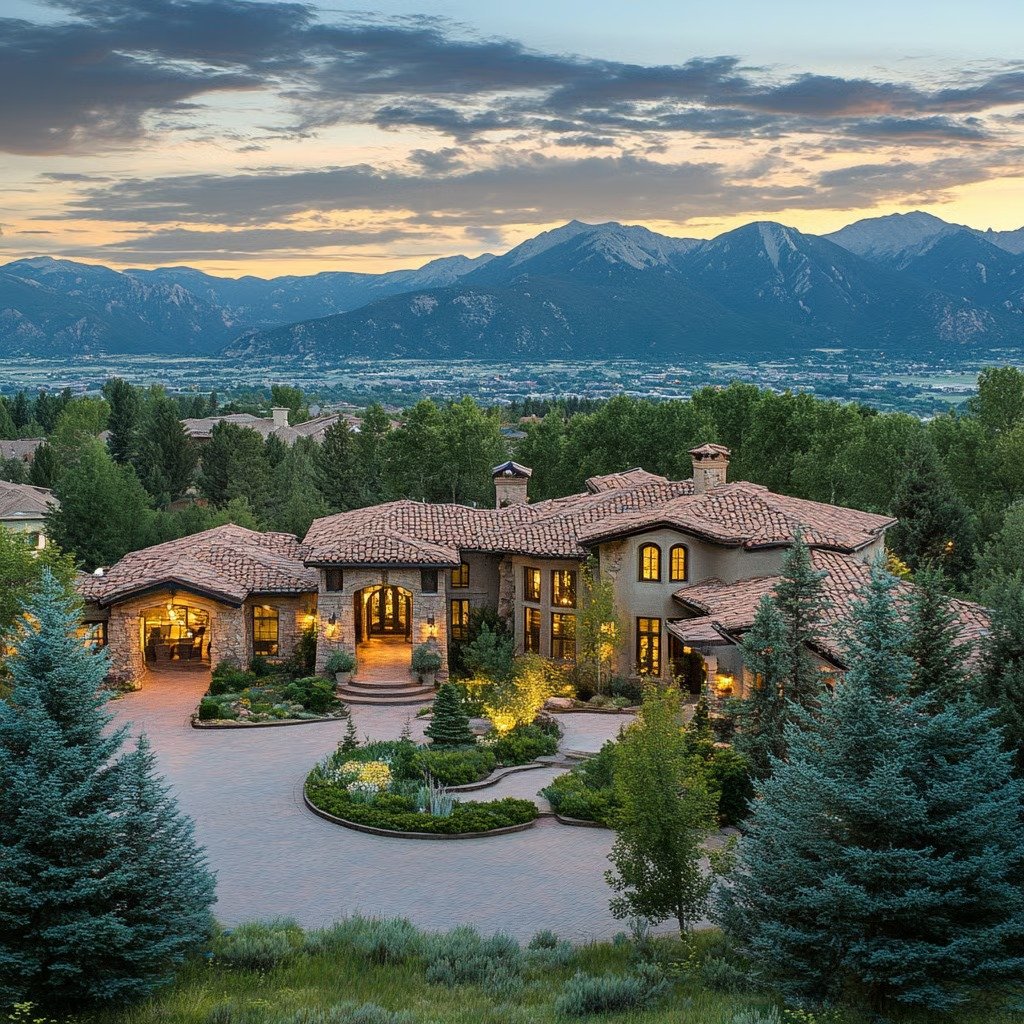
Welcome to Colorado Springs, CO
There's a reason people who move to Colorado Springs rarely leave. It isn't just Pikes Peak looming over the skyline, though that view never gets old. It's the rare combination of big-mountain access, a genuinely manageable pace of life, and a housing market that — for the first time in years — actually gives buyers room to breathe. This guide walks you through what it's really like to put down roots here, from the neighborhoods and schools to the closing-table details most agents won't think to mention until you're already under contract.
Neighborhood Overview & Location
Colorado Springs sits in the east-central part of the state, tucked against the southern edge of the Front Range where the Rockies meet the high plains. The city's footprint is large and still expanding, loosely framed by Monument to the north, the open plains of Falcon and Peyton to the east, Fountain to the south, and the steep foothills of Pike National Forest and Manitou Springs to the west.
What gives the Springs its distinct character is the way three identities coexist without much friction. There's the rugged outdoor culture — this is a place where a Tuesday morning hike before work is normal. There's the military backbone, anchored by the U.S. Air Force Academy, Fort Carson, and the Space Force installations, which shapes everything from the local economy to the steady rhythm of families moving in and out. And there's a growing layer of tech professionals, elite athletes, and remote workers drawn by the lifestyle and the relative affordability compared to Denver.
The city was founded in 1871 by General William Jackson Palmer as a refined resort destination, and that DNA still shows in the Victorian-era West Side and the storied Broadmoor. More than a century and a half later, it's grown into Colorado's second-largest city while keeping the dramatic geology — most of all the 14,115-foot Pikes Peak — at the center of daily life. As the home of the U.S. Olympic & Paralympic Committee, it also carries a quiet athletic prestige you feel everywhere from the trailheads to the training centers.
Local Real Estate Market at a Glance
After the frantic appreciation of the pandemic years, the Colorado Springs market has settled into genuinely balanced, neutral territory. Prices have stabilized, inventory has loosened, and buyers finally have time to inspect, negotiate, and walk away if a deal isn't right. For sellers, that means presentation and pricing strategy matter more than they have in a long time.
Here's where the numbers currently stand:
| Market Indicator |
Current Data |
| Median Sale Price |
~$445,000–$485,000 (standalone single-family homes run closer to $510,000) |
| Average Days on Market |
43–53 days |
| Inventory Levels |
~1.18–1.2 months of supply (up roughly 16% year-over-year, but still historically lean) |
| Year-over-Year Price Trend |
Down 0.8%–4.3% — flat to slightly softer, not a crash |
| Sale-to-List Ratio |
~98.7% |
The headline most buyers should hold onto: nearly half of active listings have taken a price reduction, and seller concessions are increasingly common. That doesn't mean the market is weak — it means leverage has shifted. A prepared buyer with a clear strategy is in a stronger position here than at any point in recent memory, and a seller who prices realistically and presents well still moves quickly.
Lifestyle & Things to Do
Life in the Springs tilts heavily toward the outdoors, but the urban culture has matured fast over the last decade.
The crown jewel is Garden of the Gods, a National Natural Landmark where 300-foot red sandstone formations rise against the backdrop of Pikes Peak. It's free, laced with paved and dirt trails, and busy with hikers, climbers, and runners year-round. For something more punishing, the Manitou Incline climbs over 2,000 feet in under a mile across 2,744 old railroad-tie steps — a rite of passage for locals. Closer in, Palmer Park offers rugged mountain biking right inside the city, while North Cheyenne Cañon delivers shaded creekside hikes to Helen Hunt Falls and the Seven Bridges Trail. South of town, Cheyenne Mountain State Park rounds things out with camping and wildlife.
The food and drink scene has real range. At the high end, The Broadmoor's collection of restaurants sets the standard. For everyday character, head to Downtown, Old Colorado City, or the Ivywild School — a 1916 schoolhouse reborn as a marketplace and neighborhood anchor. Local favorites include The Rabbit Hole, a subterranean speakeasy, plus breweries like Phantom Canyon and Bristol Brewing Company. For shopping, Old Colorado City offers brick-lined streets full of galleries and antique shops, while The Promenade Shops at Briargate covers the upscale, open-air retail on the north side.
When you want culture, the city delivers there too. The U.S. Olympic & Paralympic Museum downtown is one of the most accessible and interactive museums in the country. The Cheyenne Mountain Zoo — America's only mountain zoo — is famous for hand-feeding giraffes with the whole city spread out below you. And The Broadmoor itself, a five-star resort that's hosted presidents for over a century, is worth a visit even if you're not staying the night.
Schools & Education
Education in Colorado Springs is shaped by a strong tradition of school choice, which lets families apply to schools outside their neighborhood boundaries when space allows. That flexibility matters, because the city is carved into several distinct public districts, each with its own personality.
Academy School District 20, serving the north, is consistently one of the highest-rated districts in the state, with strong test scores and robust STEM programs — a major reason families gravitate toward neighborhoods like Briargate and Cordera. Cheyenne Mountain School District 12, in the affluent southwest foothills, is small but routinely ranks among Colorado's very best for graduation and college-readiness rates. Colorado Springs District 11 anchors the central and downtown core with diverse offerings including International Baccalaureate and magnet programs, while Falcon District 49 covers the fast-growing eastern suburbs with an innovative, workforce-readiness bent and strong charter partnerships.
On the private and charter side, The Colorado Springs School offers a prestigious, non-religious, experiential education from Pre-K through 12. Faith-based families often look to Evangelical Christian Academy and St. Mary's High School, and the Vanguard School, a top-rated K–12 charter in District 11, draws families wanting a rigorous classical curriculum.
Higher education is a real economic engine here. The United States Air Force Academy is both a premier institution and a north-side landmark. The University of Colorado Colorado Springs (UCCS) is a fast-growing research university known for business, engineering, and nursing. Colorado College, a selective downtown liberal arts school, runs its distinctive "Block Plan" where students take one intensive course at a time. And Pikes Peak State College is the region's largest institution, with a deep bench of associate degrees and career certifications.
Getting Around: Commute & Accessibility
Colorado Springs is a driving city, plain and simple — but its logical, grid-like highway system keeps traffic far more civilized than what you'd find in Denver. Interstate 25 is the spine, running north-south and connecting you to Denver in about an hour and Pueblo in about 45 minutes. Powers Boulevard (Highway 21) is the eastern expressway absorbing most of the suburban growth, and U.S. Route 24 runs east-west, heading into the mountains toward Woodland Park one direction and out to the plains the other.
Public transit exists in the form of Mountain Metropolitan Transit, which covers the main corridors, downtown, and the link to Manitou Springs — but routes are limited and infrequent, and only about 1% of residents rely on it to commute. Most people drive, and the payoff is a remarkably short average commute of just 21 to 23 minutes, well under the national average.
Jobs cluster around the defense and tech sectors: downtown, the Interquest/Briargate tech corridor in the north, and the major military installations — Fort Carson to the south, Peterson and Schriever Space Force Bases to the east, and the Air Force Academy to the northwest. For travel, Colorado Springs Airport (COS) is a low-stress gem reachable in 15–20 minutes from most central addresses, while Denver International is about 75–90 minutes north when you need broader international connections.
Types of Homes & Architecture
The architecture of Colorado Springs reads like a timeline of the city's growth — historic charm in the core, master-planned uniformity on the edges.
In the historic districts downtown and in the Old North End, you'll find Victorian, Queen Anne, and Craftsman bungalow homes built between the 1880s and 1930s, full of intricate woodwork, deep front porches, and detached alley garages. The central and south neighborhoods near Palmer Park and the Broadmoor lean toward 1950s–70s split-levels, bi-levels, and sprawling mid-century ranches. Out in the north and east master-planned communities — Briargate, Cordera, Banning Lewis Ranch, Falcon — the construction is newer (1990s to today), favoring Modern Prairie, Colorado Farmhouse, Spanish Eclectic, and two-story stucco designs with open layouts and built-in smart tech.
Pricing tracks closely with style and location. Condos and townhomes generally run $275,000 to $380,000, making them a natural fit for first-time buyers and military families wanting low-maintenance living. Standard single-family suburban homes typically land between $430,000 and $570,000, especially in sought-after districts like Academy 20. At the top end, luxury and historic estates in the Old North End or the Broadmoor enclave routinely command $900,000 to $2.5M and beyond.
Lot sizes vary just as much as the homes. Older central neighborhoods often surprise people with generous, mature lots of 0.15 to 0.35 acres shaded by towering pines, while newer suburban parcels are tighter and more uniform at 0.11 to 0.18 acres, trading yard for square footage. Push out toward Peyton or up into the foothills and you'll find equestrian and mountain properties spanning 1 to 5-plus acres.
What to Know Before You Buy Here
This is where local experience earns its keep, because Colorado's topography and dry climate create a few wrinkles that catch out-of-state buyers off guard.
First, understand the HOA reality in newer communities. Buy in a master-planned neighborhood like Cordera, Banning Lewis Ranch, or Wolf Ranch, and you'll likely answer to both a master HOA and a sub-HOA, with covenants that govern everything from how much of your yard must be live sod to where your trash cans sit and what color your trim can be. Many of these same subdivisions also operate inside a Metropolitan District, which funds roads, parks, and pools through bonds repaid via a mill levy added to your property tax bill rather than monthly dues. It can quietly add thousands to your annual carrying costs, so always pull the specific district's tax breakdown before you commit.
Second, take water rights seriously, especially on the city fringes. Colorado runs on a "first in time, first in right" system, which means a creek running through your land or an aquifer beneath it doesn't automatically give you the right to use that water. If you're buying a well-served property under 35 acres in places like Black Forest or Peyton, the permit is usually restricted to "in-house use only" — no lawn irrigation, no pool filling, no watering livestock — unless a decreed augmentation plan is in place. It's a lifestyle question disguised as a legal footnote.
Third, expect severed mineral rights. Across much of El Paso County, sub-surface rights to oil, gas, and gravel were split off from the surface decades ago, and your title commitment will list those exceptions explicitly. Finally, watch the plat for drainage and utility easements — the hilly terrain and sudden summer storms make these common, and you can't build sheds, decks, or retaining walls over them — and for wildfire mitigation zones on properties backing up to the foothills near Rockrimmon or the Broadmoor, which require you to maintain defensible space.
Closing Costs & Estimated Numbers
Closing in Colorado is refreshingly affordable compared to coastal states, mostly because there are no hefty mortgage recording taxes. By local custom, the seller pays for the owner's title policy while the buyer covers their lender-related fees.
A few typical ranges: on a $500,000 home, the title premium runs roughly $1,200 to $1,500. The escrow/closing fee is usually a flat $400 to $600, frequently split 50/50. Recording fees in El Paso County are minimal — around $40 to $80 total. Transfer taxes are rare in the city proper, though a handful of custom or mountain communities carry a private HOA transfer fee of 0.5% to 1.0%.
Here's how a sample transaction shakes out, based on a $500,000 sale price, a $300,000 remaining mortgage, and standard 5.5% total commissions:
| Party |
Expense Item |
Estimated Cost |
| Buyer |
Down Payment (10%) |
$50,000 |
| |
Loan Origination & Appraisal |
$1,800 |
| |
Lender's Title Policy |
$450 |
| |
Prepaids & Escrows |
$2,200 |
| |
Closing/Escrow Fee (50%) |
$250 |
| |
Total Out-of-Pocket |
$54,700 |
| Seller |
Gross Sale Price |
$500,000 |
| |
Commission (5.5%) |
–$27,500 |
| |
Mortgage Payoff |
–$300,000 |
| |
Owner's Title Premium |
–$1,350 |
| |
Closing/Escrow Fee (50%) |
–$250 |
| |
Prorated Taxes & Recording |
–$1,200 |
| |
Estimated Net to Seller |
$169,700 |
One detail worth flagging: Colorado property taxes are paid in arrears, so at closing the seller credits the buyer for the portion of the year they occupied the home. That proration is already baked into the figures above.
Common Title Considerations in This Area
A clean-looking property can still carry a complicated title in El Paso County, and the same handful of issues surface again and again. Severed mineral rights and oil/gas leases are everywhere in the eastern reaches — Falcon, Peyton, and the land near the airport — where the mineral estate was carved off during early homesteading, leaving title policies to exclude coverage for minerals a third party may still control. Metropolitan District and HOA liens are increasingly common on the north and east sides, where pending infrastructure assessments or unpaid master-association dues can cloud a title if they aren't caught early.
On the West Side, Broadmoor, and out in Black Forest, infill development has produced a wave of flag lots — homes set behind another property and reached by a long driveway — where the access and utility easements must be confirmed as recorded, assignable, and free of maintenance disputes. And in the oldest neighborhoods downtown and in Old Colorado City, as well as rural El Paso County, original surveys relied on physical landmarks that have since shifted, so it's not unusual to find fences, driveways, or retaining walls encroaching across boundary lines, sometimes requiring a formal boundary agreement before closing. None of these are deal-killers on their own — but each is far easier to resolve when it's identified early by a title team that knows the territory.
Local Resources & Contacts
A few offices and providers you'll likely interact with as a homeowner here:
- El Paso County Clerk and Recorder — deed recordings, plat maps, lien searches. 1675 W. Garden of the Gods Rd., Colorado Springs, CO 80907 · (719) 520-6200
- El Paso County Assessor — property taxes, mill levies, Metro District designations. 1675 W. Garden of the Gods Rd., Suite 2300 · (719) 520-6600
- Colorado Springs Utilities (CSU) — municipal electricity, gas, water, and wastewater for most of the city. (719) 448-4800
- Black Hills Energy — natural gas in certain suburban pockets outside the core. (888) 890-5554
- Mountain View Electric Association (MVEA) — electricity for rural and fringe areas like Falcon, Peyton, and Black Forest. (800) 388-9881
Talk to a Colorado Springs Real Estate Expert
Buying or selling in Colorado Springs rewards local knowledge — the kind that flags a Metro District mill levy before you fall in love with the house, or spots a severed mineral exception while there's still time to ask questions. That's where having the right closing partner makes the difference between a smooth signing and a stressful one.
First Alliance Title brings exactly that kind of grounded, on-the-ground expertise to the Front Range, with robust escrow, mobile closing, and title processing that regularly serves the Colorado Springs metro directly. Their team is known for quick turnaround and for walking clients through the parts of a transaction that usually go unexplained. Whether you're a first-time buyer, relocating with the military, or selling a longtime family home, they're a resource you can lean on from the first question to the final handshake. Reach their central closing team at (303) 565-2320, email [email protected], or connect with leadership directly — President Maggie Bateman at (303) 909-0052 or Vice President Gracie Gallego at (720) 317-9424. When you're ready to make Colorado Springs home, they're ready to help you get there.