Welcome to Denver Tech Center (DTC), CO
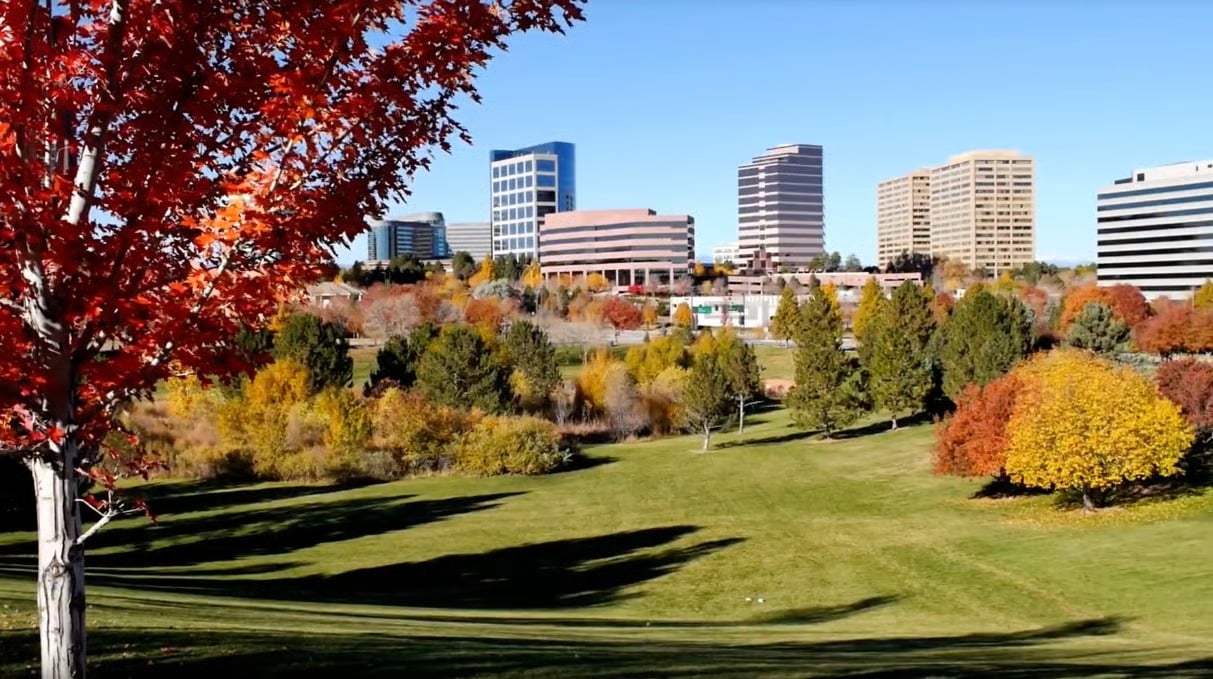
The Denver Tech Center is one of the Mountain West's most recognizable economic anchors, and understanding it means letting go of the idea that it's a single "neighborhood" in the traditional sense. It's an edge city — a 850-plus acre corporate corridor that has spent the last two decades transforming from a clinical, car-centric office park engineered in the 1960s and 70s into a genuine live-work-play ecosystem. The towering reflective-glass high-rises and wide parkways are still here, but they now share the landscape with high-density residential towers, walkable retail hubs, and some of the most premium dining in the south metro.
What makes the DTC distinct as a place to buy or rent is precisely what makes it complicated. It is not its own municipality. Its footprint spans portions of southeast Denver and the upscale suburb of Greenwood Village, and it functions as the gateway to the affluent South Metro, bridging urban Denver with the residential communities of Arapahoe and Douglas counties. That patchwork of jurisdictions is the single most important thing a buyer needs to internalize early, because it shapes everything downstream: home values, school assignments, tax bills, and title work all shift depending on which side of a given street you land on.
Location and Setting: Where the DTC Sits in the Metro
The DTC sits roughly 12 miles due south of Downtown Denver, built directly along the Interstate 25 corridor at the critical junction where I-225 branches east toward Aurora and Denver International Airport. That position gives it a rare combination of urban access and suburban breathing room — you're close enough to downtown to commute in under half an hour by rail, yet close enough to open space to be on a dirt trail within five minutes.
That last point is worth dwelling on. The Tech Center sits directly west of Cherry Creek State Park, so the transition from a high-rise office floor to 4,000 acres of open space and a reservoir is genuinely a matter of minutes, not a weekend expedition. The environment inside the district itself is a study in contrast: contemporary residential complexes and pedestrian retail districts have grown up around and between the legacy corporate towers, softening what was once a purely commercial grid. For a buyer weighing the DTC against other south metro options, the setting delivers something unusual — the density and amenity of a downtown submarket without the parking friction, paired with immediate access to the outdoors.
Real Estate Market Snapshot
The DTC housing market in 2026 reflects what might best be described as the great stabilization. The chaotic price surges of the early 2020s have leveled into a balanced, predictable environment, and that steadiness is arguably its most attractive feature right now.
Because the DTC is an enormous employment hub, housing demand across the surrounding zip codes — Greenwood Village, Centennial, and southeast Denver — remains resilient. The median home price across the broader Denver metro sits firmly around $614,000, though the immediate neighborhood surrounding the Tech Center leans significantly higher, pulled up by luxury single-family homes and high-end townhomes. Buyers are moving at a measured pace, with homes averaging about 19 days on the market, and mortgage rates have largely settled into the low-to-mid 6% range. That rate environment has produced a mild "lock-in effect," with sellers holding onto older, cheaper loans, but a steady stream of new luxury condo developments keeps upscale, low-maintenance inventory flowing for buyers who want it.
On the commercial side, the story is one of resilience against a national headwind. While central business districts across the country have struggled, the DTC office market has shown early signs of an inflection point. Vacancy rates in the submarket have begun to level out, and there's a distinct flight-to-quality underway — modern, amenity-rich Class A buildings are capturing the bulk of tenant demand, driven by tech, finance, and legal firms executing mid-sized relocations and upgrades rather than sweeping expansions. Available sublease space has dropped consistently over the past two years, a reliable signal that companies have finally right-sized their hybrid models and intend to keep the space they hold. For a residential buyer, a healthy office market matters more than it might seem: it's the underlying engine keeping local housing demand durable.
Housing Types and Architecture: Condos, Lofts, and Executive Homes
The residential architecture of the DTC tells the story of its growth, and it splits cleanly into three distinct products, each serving a different buyer.
At the core are the high-rise condos and high-end townhomes — the sleek glass-and-steel mid- and high-rises that represent the district's shift toward urban luxury. Enclaves like Penterra Plaza and the Landmark Towers feature floor-to-ceiling windows framing unobstructed Front Range views, open-concept plans, and expansive balconies or private rooftop decks. Living here mimics a five-star hotel: 24/7 concierge, private wine lockers, fitness centers, and resort-style pools. Pricing generally runs from around $600,000 for standard mid-rise flats to well over $1.15 million for penthouses in premier developments.
Tucked right behind the corporate towers sit the low-rise lofts and multi-level townhouses — transitional neighborhoods such as the Roundtree and The Corridor enclaves. These homes lean into soft-industrial and transitional architecture, mixing brick, timber, corrugated steel, and concrete. They favor vertical living, often with attached garages, soaring 12-foot ceilings, and dedicated office nooks tailored to the hybrid tech workers who fill the district.
A few minutes' drive from the glass towers, the density drops sharply into the prestigious executive single-family homes of Greenwood Village and Cherry Hills Village. Here you'll find large, multi-acre lots and architecture that runs from sprawling custom Craftsmans to modern European manors and updated Mid-Century Modern estates, flanked by mature tree canopies, horse trails, and top-tier public schools. Because of the privacy and premium acreage, these homes routinely command anywhere from $1.5 million to upwards of $5 million and beyond. The practical takeaway: within a five-minute radius you can find a $600,000 flat and a $4 million estate, and choosing between them is really a choice between lifestyles.
Lifestyle and Amenities: Dining, Shopping, and Entertainment
DTC's lifestyle is curated for affluent professionals, business travelers, and families who want downtown-level sophistication without the downtown headaches. Nowhere is that clearer than the dining scene, which built its reputation on heavy-hitting power dining and has since diversified considerably. The corporate headquarters nearby support some of Denver's most celebrated upscale eateries — mainstays like Ocean Prime in the Belleview Promenade and Shanahan's Steakhouse deliver white-tablecloth service, seafood towers, and prime Colorado steaks and lamb. For everyday living, residents lean on upscale-casual favorites like Snooze A.M. Eatery for brunch, Pint Brothers Alehouse for Colorado craft beer, and ViewHouse Centennial as a reliable local hub.
Shopping ranges from the micro-walkable to the monumental. The Landmark and Belleview Station are pedestrian-friendly, mixed-use districts offering boutique retail, day spas, boutique fitness concepts, and wellness services. A short five-to-ten-minute drive south sits Park Meadows Mall, a "retail resort" wrapped in a timber-and-stone ski-lodge aesthetic that anchors shopping for the entire south metro with luxury department stores and high-street fashion.
Entertainment is where the DTC quietly overdelivers. The Landmark development serves as the cultural heart of the district's nightlife, home to the iconic Comedy Works South — a premier venue that draws top national stand-ups — with an upscale theater next door pairing indie and blockbuster films with craft cocktails. Most striking of all is Fiddler's Green Amphitheatre, a 17,000-seat outdoor venue sitting right among the office towers, hosting major touring rock, pop, and country acts all summer. Residents can genuinely walk from a condo or office straight to a world-class concert. Rounding it out, spots like Topgolf Centennial and Upstairs Circus provide experiential, casual social options for team outings or date nights.
Working in the DTC: Employers and the Business Landscape
The name suggests a singular focus on technology, but the DTC's economy is far more diversified than that — it holds one of the largest concentrations of corporate headquarters in the American West, and understanding that mix explains the district's durable housing demand.
The corporate footprint spans several major pillars. In aerospace and engineering, the area is a hub for defense and space firms including Boeing, Sierra Space, and United Launch Alliance. In telecommunications and technology, the corridor anchors legacy giants like Charter Communications, EchoStar (DISH), and Comcast, alongside enterprise software and fintech names such as Xero, Datadog, Charles Schwab, and Empower Retirement, many occupying multi-building campuses. And in corporate logistics, Arrow Electronics — a global Fortune 100 company — anchors its sweeping headquarters right on the district's periphery.
The business landscape has settled firmly into a mature hybrid model. The gridlocked Monday-through-Friday rush of a decade ago has softened as companies adopted hub-and-spoke real estate strategies, keeping their Class A regional headquarters in the DTC for collaboration, client meetings, and executive work while giving employees localized flexibility. For a homebuyer, this matters: it means proximity to the office remains valuable, but the district isn't hostage to a single industry or a single commuting pattern.
Commute and Accessibility: I-25, the Light Rail, and Beyond
Getting in and out of the DTC comes down to managing the geography of the South Metro corridor, and the good news is that the district gives you two very different ways to do it.
The highway spine is Interstate 25, the single arterial connecting Denver to Colorado Springs. Because the entire district is built along it, the infrastructure is highly developed but prone to predictable bottlenecks — peak slowdowns hit hardest at the Belleview, Orchard, and Arapahoe interchanges during the 7–9 AM and 4–6:30 PM windows. At the district's northern tip, the I-225 interchange feeds directly toward Aurora and Denver International Airport, a genuine convenience for frequent business travelers.
For those who'd rather skip the highway entirely, RTD's light rail is the district's saving grace. The E Line runs continuously along the I-25 corridor, linking the DTC directly to Denver Union Station downtown, while the R Line cuts east to connect Tech Center professionals to the Anschutz Medical Campus in Aurora. Key stations — Belleview, Orchard, and Arapahoe Center — feature large park-and-ride garages and function as pedestrian springboards straight into the office plazas and surrounding luxury residential. And to solve the "last mile" between a platform and a specific tower, the district runs the DTC FlexRide, a free on-demand shuttle that circulates through the office parks. The practical upshot for a buyer: living in the DTC core, you can realistically build a daily routine that never touches I-25 at rush hour.
Schools and Education in the DTC Area
The DTC is nearly synonymous with elite public education in Colorado, and families routinely pay a premium for real estate here specifically to secure a spot in its feeder programs.
The vast majority of the residential footprint falls within the Cherry Creek School District, consistently ranked among the best public districts in the state, with a graduation rate well over 91%. Its flagship is Cherry Creek High School — "Creek" — located in Greenwood Village, which functions almost like a mini-university, supporting over 3,800 students and offering more than 50 Advanced Placement and Honors courses while remaining a perennial powerhouse in both athletics and academics. The district's forward-looking crown jewel is the Cherry Creek Innovation Campus, a career-and-college facility offering hands-on training in advanced manufacturing, aerospace engineering, computer science, and health sciences — fields that align almost perfectly with the employers right down the street.
For families seeking independent education, the surrounding corridor delivers as well. Kent Denver School, just northwest of the DTC, is a prestigious co-educational college-preparatory school set on a 200-acre campus and known for its academic rigor and arts programs. A short drive away, Regis Jesuit High School offers separate boys' and girls' division campuses and draws heavily from Tech Center families. One critical caveat that belongs alongside any discussion of schools here — physical proximity to a great school does not guarantee enrollment in it, a point covered directly in the buyer considerations below.
Parks, Recreation, and the Outdoors
For all its corporate density, the DTC area is remarkably green — the original master planners deliberately balanced asphalt and office towers with trail networks and recreation preserves, and that foresight pays off daily for residents.
The centerpiece is Cherry Creek State Park, which borders the eastern edge of the Tech Center: an 880-acre reservoir surrounded by 4,000 acres of open space. On the water, a full marina supports summer boating, jet-skiing, paddleboarding, and sailing. On land, 35 miles of multi-use trails include the Cherry Creek Trail, which cyclists can ride completely traffic-free all the way into downtown Denver. And for pet owners, the park's legendary 107-acre off-leash dog area — complete with water access — is a genuine south-metro institution.
Closer in, a set of micro-parks offers midday escapes right within the corporate grid. Tommy Davis Park in Greenwood Village pairs paved walking paths and a playground with lush wetlands, ideal for a quiet lunch break. Westlands Park is widely considered one of the best children's parks in the entire metro, with multi-level climbing structures, water features, a disc golf course, and playing fields framed by mountain views. And for something more rugged, the Marjorie Perry Nature Preserve offers unpaved paths and protected wetlands with panoramic Front Range views — a favorite for catching sunset over Mount Blue Sky.
Who Lives Here: The DTC Buyer and Renter Profile
The DTC's population skews heavily toward highly educated, upwardly mobile professionals — more than 80% of residents hold a bachelor's degree or higher, and roughly 97% work in white-collar industries. But the community splits into two fairly distinct groups depending on whether you're renting or buying.
Renters dominate the immediate DTC core, drawn by high-density luxury apartments and the ability to walk or ride to work. This cohort is largely single professionals or young couples in their late 20s to mid-30s, many of them corporate transplants relocated by the area's engineering, aerospace, and fintech firms. They choose the Tech Center specifically to avoid the downtown commute while keeping a maintenance-free, amenity-rich lifestyle near transit, and with average individual income around $85,000, they carry real spending power for premium mid-rise flats.
Buyers look different, and they tend to move quickly from the high-rise core out into the surrounding neighborhoods. This group skews toward mid-career executives, established tech professionals, and families seeking stability. Their motivations are consistent: schools and space. They anchor themselves in the Cherry Creek School District or seek the privacy of executive lots in Greenwood Village and Centennial, trading the walkability of the office towers for quiet cul-de-sacs, multi-car garages, and large yards — all while keeping their commute under ten minutes. Recognizing which of these two profiles you fit is the fastest way to narrow down where in the district you should actually be looking.
Buyer Considerations: What to Know Before You Purchase
If you're planning to buy in or around the DTC, three structural realities will materially affect your investment, and none of them are obvious from a listing photo.
The first is the HOA premium. If you're buying a condo or loft in the high-rise districts like The Landmark or Penterra Plaza, you have to account for substantial Homeowners Association dues. Because these communities deliver resort-style amenities — 24/7 concierge, secure underground parking, private fitness centers, pools — monthly HOA fees can easily run from $400 to over $900. Crucially, these dues factor directly into your debt-to-income ratio when qualifying for a mortgage, so they can affect not just your monthly budget but the size of the loan you're approved for.
The second is the dramatic price discrepancy across borders. Because the DTC isn't its own municipality, home values swing wildly depending on exactly which zip code or city limit you land in. A luxury condo inside the immediate DTC core might sell for a median in the $371,000 to $600,000 range, but cross into the city limits of Greenwood Village (ZIP 80111) and the typical home value jumps sharply to around $1.42 million, driven by strict zoning that prioritizes large single-family acreage. Two homes a short walk apart can occupy entirely different price universes.
The third — and easiest to get wrong — is the school district boundary trap. Do not assume that a home's physical closeness to the DTC automatically places it in the prestigious Cherry Creek School District. The boundaries of Denver Public Schools and Cherry Creek Schools weave intricately through the area, and homes on the very same block can feed into entirely different systems. If top-tier public schools are a primary driver of your purchase, always verify the district lines independently rather than trusting a listing summary. This is exactly the kind of detail where a knowledgeable local closing partner earns their keep.
Closing Costs and What to Expect at the Table
Once you've found the home, the transaction shifts from aesthetics to financial mechanics, and Colorado closings follow their own distinct customs. Nearly everything is technically negotiable in a Colorado contract, but local convention drives who typically pays what.
For the buyer, closing costs generally land between 2% and 5% of the purchase price. On a $650,000 home — roughly the DTC baseline — that means budgeting somewhere between $13,000 and $32,500 on top of your down payment. That figure covers lender fees (origination, underwriting, processing, and credit checks, often $1,500–$4,000), prepaid escrow cushions for the first year of homeowners insurance plus a multi-month buffer for property taxes, and — specific to this market — a one-time HOA working capital fee. Because so much DTC real estate sits within master associations, buyers are frequently asked at the table to contribute two or three months of standard dues to buffer the community's reserves.
For the seller, costs run heavier, typically 6% to 10% of the sale price, driven mostly by real estate commissions. Two Colorado-specific line items are worth flagging. First, the state's Documentary Fee is refreshingly low — a flat $0.01 per $100 of sale price, meaning a $1 million Greenwood Village estate incurs a negligible $100. Second, Colorado property taxes are paid a year in arrears, so at closing the seller credits the buyer for the days they occupied the home during the current calendar year, since the buyer will ultimately receive the full tax bill the following year. Understanding these prorations in advance prevents unwelcome surprises on the settlement statement.
Title and Escrow Considerations in the DTC
Unlike states where attorneys run closings, Colorado relies almost exclusively on independent title insurance companies acting as neutral third-party escrow agents — they hold the funds, perform the title search, clear liens, and facilitate the signing. Understanding how that works, and where the DTC adds complexity, is where an experienced title partner becomes essential.
The customary split of title and escrow costs in the Denver and DTC markets typically breaks down as follows:
Closing Item | Standard Denver/DTC Custom | Cost Estimate (on a $650k home) |
|---|
Owner's Title Policy | Paid by Seller | $1,600 – $2,200 |
Lender's Title Policy | Paid by Buyer | $150 – $300 (simultaneous issue rate) |
Closing/Settlement Fee | Split 50/50 | $300 – $500 each |
Recording Fees | Paid by Buyer | $40 – $150 |
One advantage worth understanding is that Colorado operates on an open-filing system for title insurance. Unlike states such as Texas, where rates are set by the government, Colorado title companies file their own independent rate structures with the Division of Insurance. Because the DTC is the corporate and financial epicenter of the south metro, virtually every major national title firm maintains a flagship office right in the Tech Center, and that concentration of competition works in the consumer's favor — buyers and sellers are free to shop around for the most favorable premiums and escrow fees rather than accepting a default rate.
Two local complexities deserve special attention during the title commitment phase. The first is special district taxes: many newer luxury and mixed-use developments around Belleview Station were built using Metro Districts, special governmental entities that fund public infrastructure. A thorough title search must check for outstanding Metro District bonds, because they add a separate mill levy to your annual property tax bill. The second is HOA liens: given the district's high concentration of vertical condo living, the title company must request an official HOA Status Letter. If a prior owner fell behind on those substantial monthly dues, the association can place a super-lien on the property that must be fully paid off by the seller before title can clear. Both are exactly the kind of issue that a title company unfamiliar with the DTC can miss — and that a local expert catches early.
Connect with First Alliance Title
Buying or selling in the Denver Tech Center rewards local knowledge at every stage — from confirming which school district a home actually feeds into, to accounting for a Metro District mill levy, to reading an HOA Status Letter before it derails a closing. That's precisely where First Alliance Title comes in. As a title and escrow partner with deep roots across Colorado's Front Range and mountain markets, First Alliance Title brings the kind of hands-on, detail-driven attention that a jurisdictionally complex area like the DTC demands. Whether you're closing on a high-rise condo near Belleview Station or a multi-acre executive estate in Greenwood Village, their team is ready to guide the transaction from contract to close with clarity and care. If you're planning a move in or around the Tech Center, reach out to First Alliance Title to start the conversation — and close with confidence.